Architecture
This page provides a concise summary of the "Taça UA" system architecture (C4 model), extracted from the full architecture export.
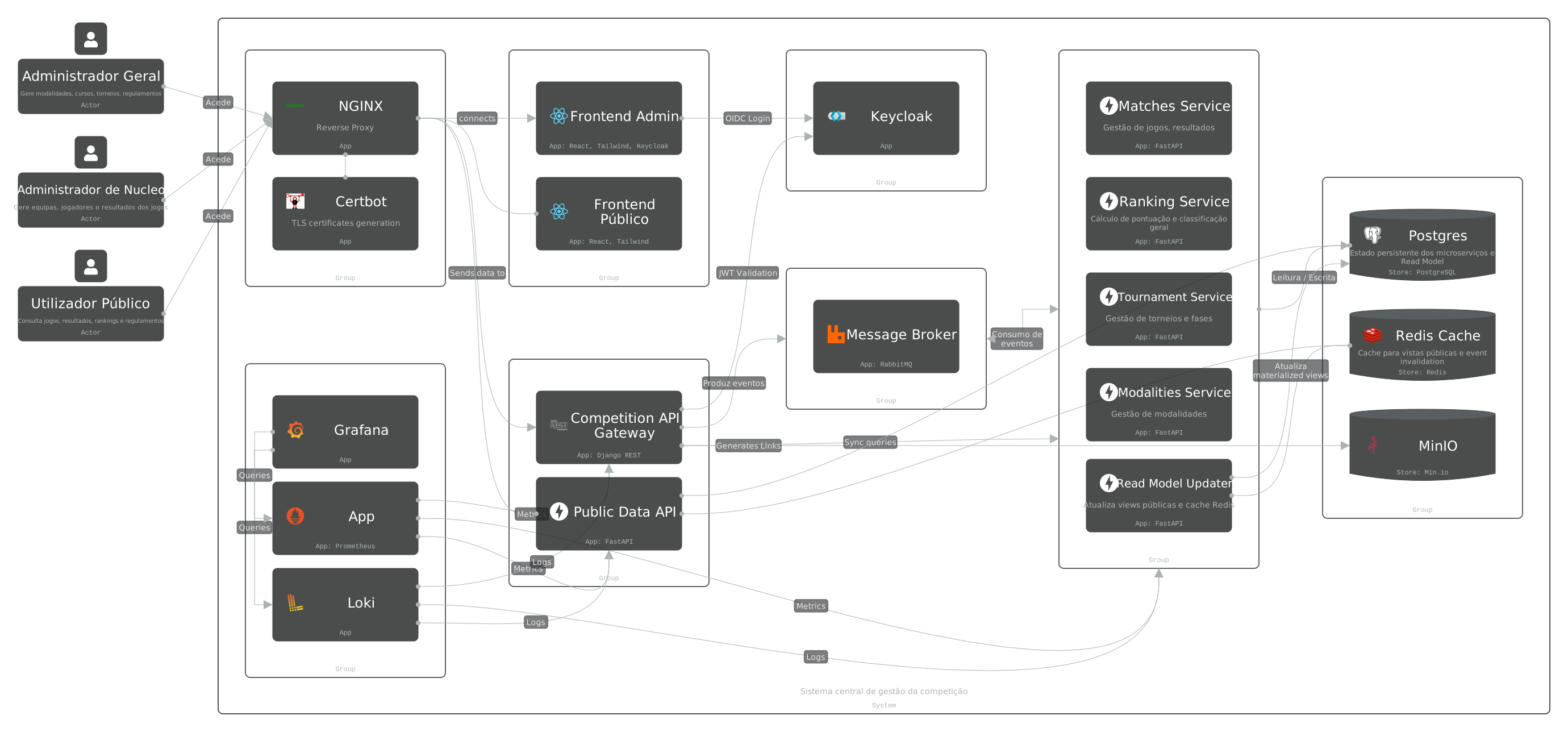
Primary actors
- General Administrator — manages the full competition: nucleos, courses, modality types, modalities, regulations, seasons, tournaments, matches and results.
- Core Administrator (Nucleo Admin) — manages their own nucleo's teams, students, staff and match lineups.
- Public User — unauthenticated access to matches, results, rankings, regulations and historical data.
Key layers and components
- Edge / Reverse Proxy: NGINX secures and routes incoming traffic.
- API Gateway (Competition API Gateway): validates JWT/OIDC tokens, emits events and generates links to object storage.
- Microservices: domain services (Matches, Tournament, Modalities, Ranking, Read Model Updater) responsible for business logic and persistence.
- Frontends: Admin dashboard (Frontend Admin) and public site (Frontend Public).
- Storage: A single PostgreSQL instance with schema-level isolation per microservice (
modalities,matches,tournaments,ranking) plus a sharedpublic_readschema of materialized views; Redis for caching; MinIO (S3-compatible object storage) for PDFs and file uploads, proxied via NGINX. - Event Streaming: RabbitMQ for event-driven communication between services using the transactional outbox pattern; Dead Letter Exchanges (DLX) for failed messages.
Core Microservices
- Matches Service: Manages matches, participants, lineups and comments; Emits versioned events like
match.created.v1,match.result.updated.v1,match.lineup.assigned.v1. - Ranking Service: Processes tournament results and calculates course scores using per-modality-type escalão (tier) point tables; Maintains
general_rankings,modality_rankingsandcourse_rankingstables. - Tournament Service: Manages tournaments and their competitors; Emits events like
tournament.created.v1,tournament.finished.v1. - Modalities Service: The most domain-rich service — manages the full hierarchy: Nucleo → Course → ModalityType → Modality → Team → Student/Staff. Emits fine-grained events for each entity (e.g.,
nucleo.created.v1,team.player_added.v1,student.created.v1). - Read Model Updater: Consumes all domain events from RabbitMQ; Upserts rows in the
public_readschema and refreshes materialized views (mv_team_details,mv_match_details,mv_tournament_standings,mv_general_ranking, etc.).
Observability and identity
- Observability: Prometheus (metrics), Grafana (dashboards) and Loki (logs).
- Identity: Keycloak as the identity provider and RBAC for administrative areas.
Technology and deployment choices
- Containerization / Orchestration: Docker Compose for both development and production deployments.
- Messaging: RabbitMQ with the transactional outbox pattern — each service writes events to a local
outbox_eventtable first, then a publisher relays them to RabbitMQ, ensuring at-least-once delivery. - Authentication: Keycloak (OIDC / JWT) with a custom theme; role-based access control distinguishes General Administrator from Core (Nucleo) Administrator.
- Object Storage: MinIO (S3-compatible), accessed through the shared
taca_storagepackage and exposed publicly via NGINX at/files/. - Reverse proxy and TLS: NGINX + Certbot (Let's Encrypt TLS certificates).
Operational patterns
- Services emit metrics and logs; centralized dashboards monitor availability and performance.
- Public reads are served from dedicated Read Models kept up-to-date by the Read Model Updater for low-latency responses.